AI in 2026: From Hype to Hard Impact
Here’s a Gwop Magazine–style deep dive into the AI trends and predictions shaping 2026 — the year artificial intelligence stops being an experiment and starts defining the future of business, work, culture, and everyday life.
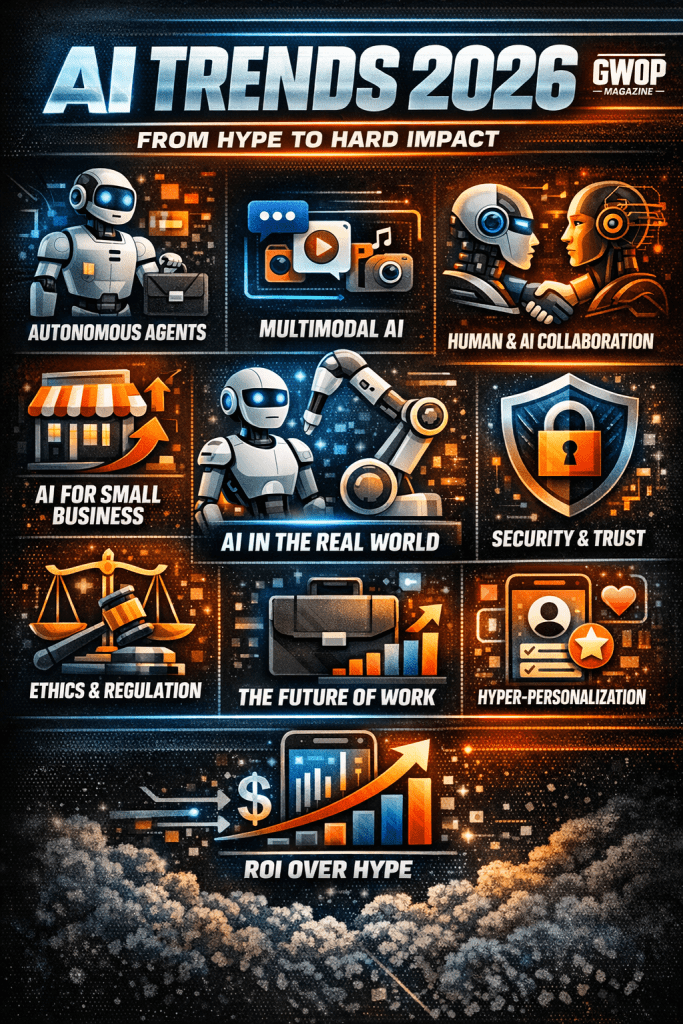
Artificial intelligence is no longer just about flashy demos and viral chatbots — 2026 is the year AI becomes embedded, indispensable, and transformative across industries and our daily routines. The focus has shifted from novelty to productivity, integration, and real-world return on investment.
Here’s what we’re seeing as the big themes:
🤖 1. Autonomous AI: Agents That Actually Work for You
Walk aside from prompt-driven chatbots — agentic AI is now real tech with real business impact. These systems don’t just answer questions; they plan, execute, monitor, and adapt workflows autonomously. Think of them as digital coworkers that handle multi-step tasks like scheduling meetings, optimizing logistics, or generating reports — with minimal human oversight.
In 2026, agent orchestration platforms will become as essential as CRM or ERP systems — reshaping how organizations operate day-to-day.
🌐 2. Multimodal AI: Understanding the World Like Humans Do
Text-only AI is old news. In 2026, models that fully integrate language, image, audio, and even video are becoming mainstream. This means systems that can interpret a product image, analyze customer reviews, and generate a marketing plan — all from one interface — will become standard.
Multimodal models also power more intuitive interactions: think assistants that can understand gestures in meetings or context from visuals and speech simultaneously.
🧠 3. AI That Works With Humans, Not Instead of Them
Leading thinkers in the field are stressing a collaborative AI future. Next year’s biggest breakthroughs won’t be about replacing humans — they’ll be about amplifying human potential. AI is evolving from a tool that answers questions into a partner that helps shape strategy and creative work.
In practice, this means companies will leverage AI not just to speed processes but to unlock new levels of human performance, from marketing to engineering to customer support.
📈 4. Democratization and Small Business Empowerment
AI isn’t just for tech giants anymore. Small businesses are now harnessing intelligent assistants for everything from sales outreach to customer service automation. In 2026, affordable AI tools will level the playing field — enabling startups and local businesses to compete with enterprise-level capabilities. We built a small ai film studio in 2025 in less than 90days; GWOP Films with the help of ai tools.
🎯 5. AI in the Real World — From Devices to Robotics
Expect AI to step out of screens and into physical reality. On-device AI — where models run locally without an internet connection — will enhance everything from enhanced privacy to faster performance on mobile and wearable devices.
Meanwhile, physical robots — from warehouse helpers to home assistants — will begin working alongside humans in more environments, transforming labor dynamics.
🔐 6. Security, Trust, and Digital Identity for AI Agents
With AI agents acting autonomously, security isn’t just important — it’s mission-critical. 2026 will see more emphasis on embedding identity, auditability, and access controls directly into AI systems to prevent misuse or compromise.
This also intersects with cybersecurity: AI will both defend and challenge defense systems, automating threat detection but also enabling more sophisticated attacks.
⚖️ 7. Governance, Ethics, and Regulation Go Mainstream
As AI capabilities grow, the conversation around responsible AI isn’t just philosophical — it’s practical. Expect widespread adoption of standardized governance frameworks, transparency requirements, and explainable AI tools in 2026, especially in industries like finance, healthcare, and government.
Major regulatory actions — including potential billion-dollar fines for ungoverned AI failures — could shift AI from “optional ethics” to enterprise necessity.
💼 8. The Workforce Is Reshaped — Not Replaced
Leading AI voices warn that 2026 could bring job displacement in some areas, especially routine white-collar work, while creating new roles in AI oversight and integration.
Rather than eliminating jobs wholesale, AI is more likely to redefine work — pushing humans into roles focused on judgment, creativity, ethics, and AI governance.
🌍 9. Hyper-Personalization Across Consumer Tech
AI in 2026 will deliver experiences so tailored they feel personal — from bespoke learning paths in education to shopping experiences that predict desires before users express them.
This isn’t just clever marketing; it’s hyper-personalized engagement that drives deeper loyalty and higher conversion rates.
🧩 10. Reduced Hype, Increased Reality
Finally, 2026 marks the year when ROI trumps hype. Enterprises will focus on measurable outcomes — efficiency, revenue, cost savings — not just the flashiest AI demos. Leaders who can integrate AI with strategy and governance — not just technology — will win in this decade.
🌟 In Conclusion
2026 isn’t about one defining AI breakthrough — it’s about AI becoming foundational. From autonomous workflows and secure digital agents to real-world robotics and ethical governance, the ai narrative is shifting from “what AI can do” to “what AI actually changes.”
This is the year AI stops being futuristic — and starts being fundamental.
Follow our Ai research at @gwop.university
 GWOP MAGAZINE
The new applications of GWOP Films are noteworthy.