Toxic Productivity: How Hustle Culture Turns Self-Improvement Into Self-Harm
Why Hustle Culture Is Making You Miserable (And How to Escape It)
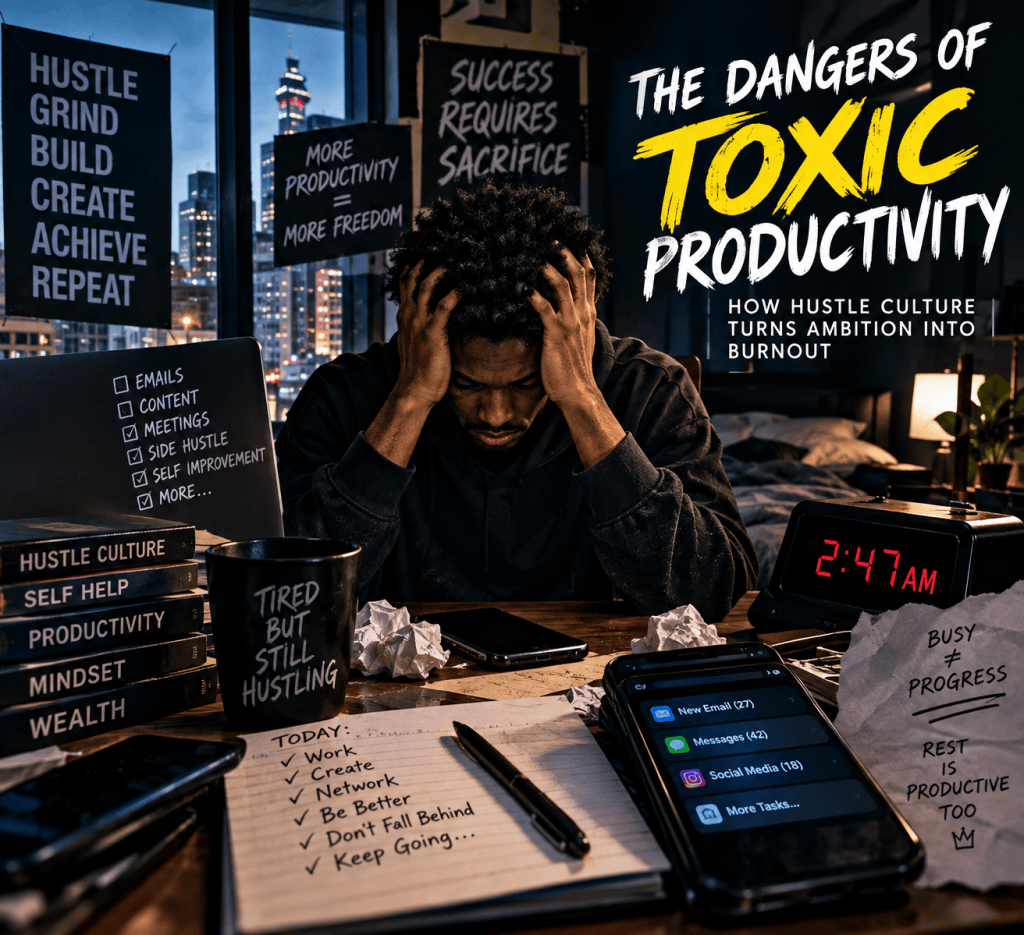
Hustle culture sold you a lie.
It told you that if you just work harder, sleep less, stack more side projects, and treat every spare minute like a business opportunity, success and fulfillment would follow. What it actually delivered for most people is chronic exhaustion, quiet resentment, and a gnawing sense that you’re never doing enough.
This isn’t motivation. It’s a productivity cult that profits from your insecurity.
The Core Scam of Hustle Culture
Hustle culture doesn’t celebrate ambition. It pathologizes rest. It turns basic human needs—sleep, downtime, relationships, unstructured thought—into moral failures.
Look at the language: “Rise and grind.” “Sleep when you’re dead.” “No days off.” These aren’t neutral slogans. They’re designed to make you feel guilty for having a nervous system that requires recovery. The people shouting them loudest are often selling courses, merch, or an identity built on never stopping.
The result? A generation of people who measure their worth by output. Who feel anxious when they’re not “optimizing.” Who confuse motion with progress and burnout with dedication.
Busy has become a status symbol. Exhaustion has become proof of seriousness. And the people who quietly protect their energy, say no, and work in focused bursts are often dismissed as lacking drive.
That’s backwards.
What Hustle Culture Actually Costs You
It steals more than sleep.
It erodes deep work. Constant context-switching and the pressure to always be “on” destroy the conditions required for original thinking. You end up producing more shallow content, more reactive tasks, and less of anything that actually matters.
It damages relationships. The partner who gets the leftovers of your attention. The friends you keep canceling on. The family moments you half-experience while checking your phone for “opportunities.” Hustle culture frames this as temporary sacrifice. For many, it becomes the permanent operating system.
It wrecks your health. Chronic stress, disrupted sleep, and the glorification of overwork are linked to anxiety, depression, weakened immunity, and long-term cardiovascular risk. The body keeps the score even when your Instagram feed pretends otherwise.
And perhaps most damaging: it hijacks your identity. When your value is tied to how hard you’re grinding, rest feels like failure. Slowing down feels like falling behind. You start needing the hustle to feel like somebody.
That’s not ambition. That’s dependency.
The Evidence Against the Grind
High performers in almost every field understand recovery is part of the work. Elite athletes periodize training. Serious writers protect long stretches of unstructured time. Sustainable businesses are built by people who can think clearly, not by those running on fumes and caffeine.
The loudest hustle advocates rarely show the full picture: the anxiety, the failed relationships, the creative droughts, the eventual crash. They show the highlight reel and sell the myth that if you’re still tired, you simply aren’t committed enough.
That’s a convenient story for anyone monetizing your dissatisfaction.
How to Escape Without Becoming “Soft”
Rejecting hustle culture does not mean rejecting ambition, goals, or hard work. It means rejecting the stupid version of them.
Start here:
- Audit the propaganda. Unfollow accounts that make you feel perpetually behind. Notice how much of the “grind” content is performance rather than results.
- Redefine productivity. Track outcomes and energy, not hours logged or tasks completed. One focused three-hour block often outperforms eight fragmented ones.
- Protect recovery like it’s a non-negotiable meeting. Sleep, walks, boredom, and actual days off are not rewards you earn after enough suffering. They are inputs that make good work possible.
- Separate your worth from your output. This is the hardest and most important shift. You are not a machine. Your value does not fluctuate with your to-do list.
- Build systems that respect human limits. Batch work. Set boundaries. Say no more often. Design a pace you can maintain for years instead of a sprint that ends in collapse.
The goal is not to become less ambitious. It’s to become harder to break.
The Quiet Alternative
The most effective people I know are not the ones broadcasting their 4 a.m. wake-ups and 90-hour weeks. They’re the ones who disappeared for a while, did focused work, protected their minds, and shipped things that actually mattered. They treat energy as a finite resource instead of an infinite virtue signal.
Hustle culture wants you overworked, slightly desperate, and constantly consuming the next productivity hack.
You can opt out.
Work hard when it counts. Rest without apology. Build a life that doesn’t require you to hate your present self in order to chase a future one.
That’s not laziness. That’s strategy.
Thanks for reading.