Why We Need More De-Influencers: Rethinking the Influencer Economy
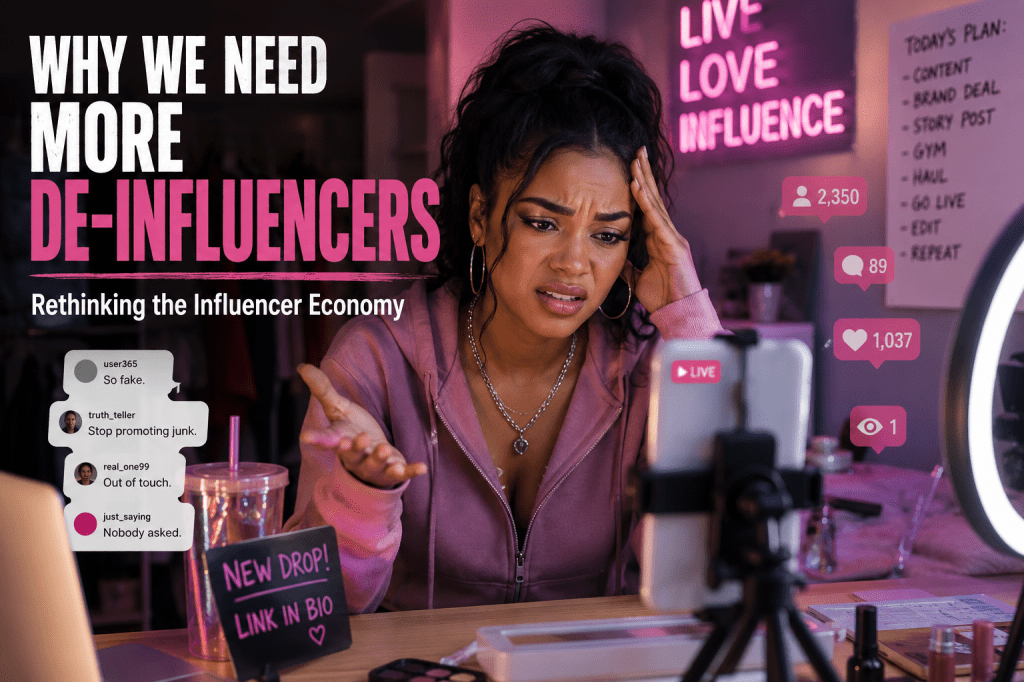
For over a decade, social media has promoted a simple narrative: anyone can become an influencer. Millions of people have been encouraged to transform their lives into content, their personalities into brands, and their daily experiences into products for consumption. While this movement has democratized media in important ways, it has also produced an economy built on comparison, constant performance, and increasingly unrealistic expectations.
A new cultural force has begun to emerge in response: the de-influencer. Rather than persuading audiences to buy more, chase trends, or imitate curated lifestyles, de-influencers encourage skepticism, intentional consumption, and critical thinking. Their rise may represent one of the healthiest developments in the digital age.
The question is no longer whether influencing has changed society. The more important question is whether society now needs more people willing to challenge influencer culture itself.
The Economics of Attention
The influencer economy operates on attention. Social media platforms reward creators who maximize engagement, often through aspirational lifestyles, emotional storytelling, controversy, or consumer recommendations.
This creates incentives that are not always aligned with the interests of viewers. Success frequently depends on convincing audiences that they are missing something—whether it is a new product, a better body, a luxury vacation, or an entrepreneurial lifestyle.
In economic terms, attention has become a commodity. Human curiosity is monetized through advertising, affiliate marketing, sponsorships, subscriptions, and algorithmic amplification. The result is an environment where visibility often matters more than substance.
The Hidden Cost of Becoming an Influencer
The popular narrative suggests that influencing offers freedom, flexibility, and financial independence. While this is true for a relatively small number of creators, it overlooks the realities facing the overwhelming majority.
Many aspiring influencers experience:
- Income instability
- Algorithm dependence
- Burnout from constant content creation
- Anxiety related to audience growth
- Pressure to remain permanently visible online
- Blurred boundaries between public and private life
Ironically, many people seeking freedom from traditional employment discover that they have become 24/7 employees of algorithms instead.
Performance Replacing Authenticity
One of the defining features of influencer culture is the transformation of ordinary life into continuous performance.
Meals become content.
Friendships become collaborations.
Vacations become marketing campaigns.
Personal struggles become engagement opportunities.
When every experience carries potential economic value, authenticity becomes difficult to separate from strategy. The distinction between living and documenting gradually disappears.
Philosopher Guy Debord argued that modern society increasingly experiences reality through representations rather than direct experience. Social media has accelerated this phenomenon by encouraging people to optimize appearances instead of cultivating meaningful lives.
Why De-Influencers Matter
De-influencers represent a cultural correction rather than simply another online trend.
Instead of asking:
“What should I buy?”
they ask:
“Do I actually need this?”
Instead of encouraging endless consumption, they encourage evaluation.
Instead of promoting endless productivity, they discuss rest.
Instead of idealized lifestyles, they often acknowledge uncertainty, financial limitations, and imperfection.
Their influence lies not in selling desire but in reducing unnecessary desire.
Consumerism Has Become Content
Advertising once interrupted entertainment.
Today, advertising often is the entertainment.
Product reviews, “must-have” lists, lifestyle vlogs, shopping hauls, and affiliate recommendations have become dominant forms of online media. Even educational content frequently concludes with sponsored products.
This constant commercialization shapes identity itself.
People increasingly ask:
- What should I own?
- What aesthetic should I adopt?
- Which productivity system should define me?
- Which creator should I imitate?
De-influencing interrupts this cycle by reminding audiences that identity cannot be purchased.
The Psychology of Social Comparison
Psychologists have long documented the effects of upward social comparison.
When people repeatedly compare themselves with carefully curated lives, they often experience lower life satisfaction, increased anxiety, and reduced self-esteem.
Influencer culture magnifies these comparisons because success is measured publicly through followers, likes, comments, sponsorships, and visible wealth.
De-influencers introduce an alternative message:
Your value is not determined by your engagement metrics.
This shift may seem subtle, but culturally it represents a profound change.
From Creator Economy to Knowledge Economy
The next generation of online success may belong less to influencers and more to educators, researchers, journalists, artists, and experts.
Rather than optimizing personalities, creators can optimize ideas.
Rather than building audiences around consumption, they can build communities around learning.
The internet becomes healthier when knowledge competes successfully against spectacle.
This transition rewards expertise over visibility and encourages audiences to value evidence, creativity, and intellectual curiosity.
Digital Minimalism as Resistance
Choosing not to pursue influencer status is increasingly an act of digital minimalism.
Not every hobby requires monetization.
Not every opinion requires publication.
Not every moment requires documentation.
The pressure to become “a personal brand” can diminish the joy of simply practicing a craft.
Artists can create without algorithms.
Writers can write without analytics.
Musicians can compose without viral ambitions.
The healthiest creative work often begins when external validation becomes secondary.
A Healthier Digital Future
This is not an argument against influencers as individuals. Many creators produce thoughtful educational content, raise awareness for important causes, and build meaningful communities.
The concern is with an ecosystem that encourages everyone to become an influencer regardless of their interests, talents, or long-term well-being.
Societies flourish when citizens are encouraged to become scientists, teachers, engineers, nurses, filmmakers, entrepreneurs, historians, philosophers, skilled tradespeople, and artists—not merely content creators chasing engagement metrics.
De-influencers remind us that success should not be measured solely by visibility. Influence without wisdom is fragile. Visibility without purpose is fleeting.
Conclusion
The internet does not necessarily need fewer voices. It needs more discerning ones.
De-influencers challenge the assumption that fulfillment comes from followers, sponsorships, and perpetual self-promotion. They encourage audiences to consume thoughtfully, create authentically, and define success on their own terms.
Perhaps the most influential people of the next decade will not be those who convince millions to imitate them, but those who give millions permission to stop performing altogether.
Thanks for Reading.


De-influencing is interesting because it still relies on influence, just in the opposite direction. Someone saying “don’t buy this” can build as much trust with an audience as recommending something good. That trust is probably the valuable bit either way.
Dopa Agency