The Slow Death of Social Media
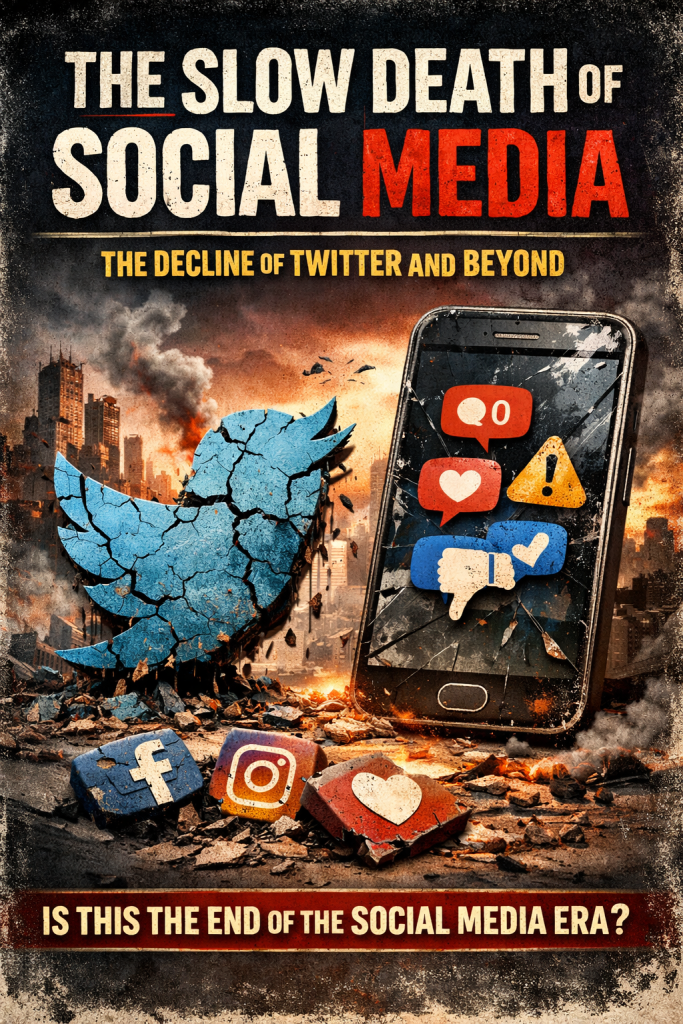
In the digital age, we’ve long treated social media as an immortal force—a constant hum in the background of our lives, shaping opinions, sparking revolutions, and occasionally ruining reputations. But as we sit here in early 2026, the cracks are impossible to ignore. Usage is plateauing, engagement is waning, and users are fleeing in droves for quieter, more intentional corners of the internet. Social media isn’t just evolving; it’s dying a slow, algorithmic death. And at the epicenter of this collapse is X, the platform formerly known as Twitter, which we predict will be functionally irrelevant—or outright defunct—within the next few years. This isn’t hyperbole; it’s a culmination of fatigue, mismanagement, and a cultural shift away from the endless scroll.
Let’s start with the broader landscape. Social media’s golden era, defined by infinite feeds and dopamine hits, is crumbling under its own weight. A recent poll from the American Psychiatric Association revealed that half of Americans cut back on social media in 2025, with even more planning to reduce usage in 2026, citing mental health concerns, AI-generated “slop,” and digital overstimulation as primary culprits. Search data paints an even starker picture: nearly 2 million Americans per month are querying how to delete or deactivate accounts across major platforms, signaling not just dissatisfaction but a mass exodus. Influencers are becoming “exfluencers,” ditching polished feeds for real-life pursuits, while trends like dumb phones as status symbols and phone-free bars underscore a societal backlash against constant connectivity.
This isn’t mere nostalgia for a pre-social era; it’s a correction. Platforms built on outrage and virality have bred environments where genuine connection is drowned out by bots, ads, and echo chambers. Journalism sees hope in this decline, predicting a “supply problem” where fake content becomes indistinguishable from real, eroding trust entirely. Users are migrating to micro-communities, substacks, and group chats—spaces that feel human rather than algorithmic. Even platform leaders admit the shift: Instagram’s head, Adam Mosseri, declared the “polished feed” dead, pushing for more authentic, AI-curated experiences. But here’s the rub: while some predict hyper-personalization and AI-generated content will revive social media by 2026, I argue it’s too little, too late. The fatigue is real, and quitting feels liberating, even if it’s lonely at first. 16
Now, zoom in on X. Once the pulse of real-time discourse, it’s now a cautionary tale of hubris and decline. Under Elon Musk’s stewardship since 2022, the platform has hemorrhaged users and revenue. Projections show a 2.7% drop in its user base to around 349 million by the end of 2025, continuing a downward spiral. Daily active users on mobile have plummeted 13.3% year-over-year, from 148.5 million in October 2024 to 128.8 million in October 2025. Young adults, the lifeblood of any social app, are fleeing: usage among 18- to 29-year-olds fell from 42% to 33% between 2024 and 2025. Overall American adoption has dipped to just 21%, overtaken by Reddit in popularity.
Why the freefall? Musk’s changes—rebranding to X, lax content moderation, and a focus on “everything app” ambitions—have alienated advertisers and users alike. Revenue in the U.K. collapsed 58% in 2024, with global ad spend projected to follow suit due to brand safety concerns and hateful content proliferation. Advertisers are exiting en masse, with surveys showing momentum building into 2025. Meanwhile, rivals are surging: Meta’s Threads has already surpassed X in daily active users, reaching 132.5 million in October 2025, thanks to aggressive integration with Instagram. Bluesky, once a liberal haven, saw gains post-2024 election but has since declined nearly 40%, yet it still siphons users frustrated with X’s bot infestation and engagement bait.
On X itself, the sentiment echoes this doom. Users lament the death of “Tech Twitter” and “Black Twitter,” overrun by grifters and bots. Views and interactions are dropping, with many declaring the app “dead” due to algorithm changes prioritizing outrage over substance. One post sums it up: “Twitter is dead. We’re just squeezing the final juice of nostalgia value out of it.” Even Musk’s attempts at revival, like declaring 2026 “the year of the creator” with higher payouts, feel desperate amid stagnant growth.
Contrarians might point to X’s claimed 600 million users or its relevance in real-time news. But independent data contradicts this: engagement is down, with likes per post falling from 37.8 in 2023 to 31.4 in 2024. The top 10% of users generate 92% of tweets, leaving most as passive scrollers in a ghost town. Without a course correction—unlikely given Musk’s combative style—X risks becoming a niche echo chamber, irrelevant to mainstream discourse.
In the end, social media’s death isn’t sudden; it’s a quiet logout. By 2030, I envision a fragmented online world: AI-curated newsletters, VR communities, and offline revivals. X won’t lead it— it’ll be a relic, much like MySpace. The question isn’t if social media is dying, but what we’ll build from its ashes. For now, perhaps it’s time to touch grass.
Thanks for reading 🗞️
Follow @gwopmagazine on all social media


 GWOP MAGAZINE